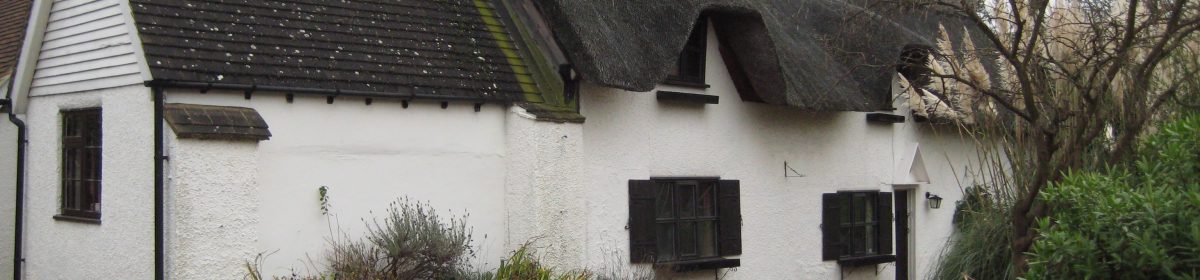
This next phase of the project was always going to be different. Restoring an existing and very old structure rather than building something new is not easy or linear. With the new extension there was a logical sequence of foundations, walls, roof, doors and windows etc. With the old building it’s a case of peeling back the layers and working it out as we go along.

The first step in restoring the old house is carefully taking off more recent additions, some of which have been damaging the timber frame and wattle and daub structure. The house was designed to breath and dry naturally. Renovations over the last fifty years or so have followed a more modern approach to try and keep damp out. The result in a house like ours is that the damp gets trapped and starts rotting the structure. So we weren’t really sure when the builders started exactly what we would find. A bit nerve-racking.
We are using builders who specialise in restoring old buildings like ours and are used to working in this way. We used them to repair one corner of the cottage in 2014 and to rebuild the chimney last year so they have an understanding of our house. They are a much bigger operation than our previous builders, Ken and Joe, with a number of projects on the go and are used to getting on with things in their own way. As a result I’ve had to be much more proactive in talking to them and finding out what they’re up to and when to make sure we get the renovation we want.
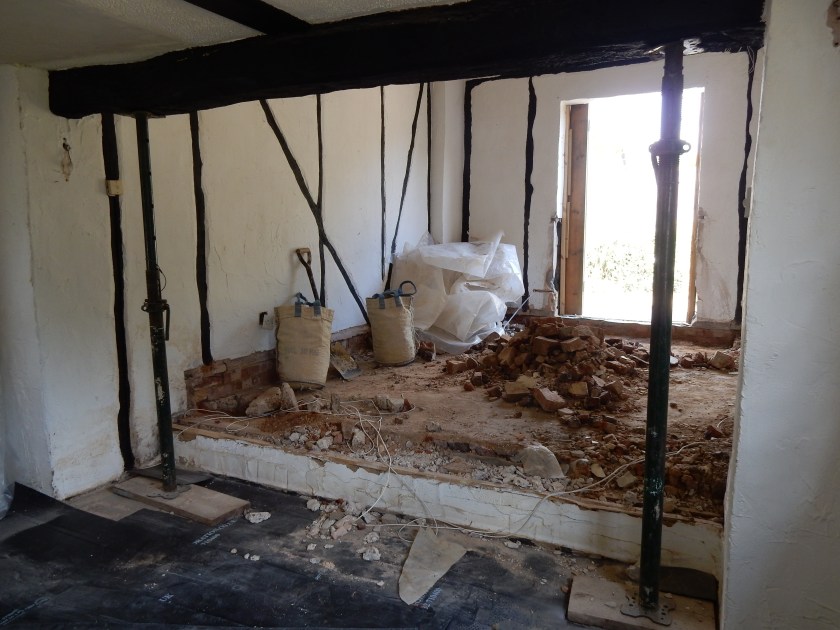
The guys (and they are all men) started inside with digging out the old smithy floor a priority to reduce it to the level of the sitting room floor in the old cottage. It didn’t take long to remove the carpet and wooden floor boards to find a solid slab of concrete underneath. Out came the power drills to break that up only to find another concrete slab underneath that one. More concerning was that this second slab was the only support for the front wall with no foundations underneath! So the first unexpected addition to the works was a visit by a structural engineer and plans for underpinning. He couldn’t understand why it hadn’t already subsided, a good thing that we discovered it when we did and could carry out remedial action.
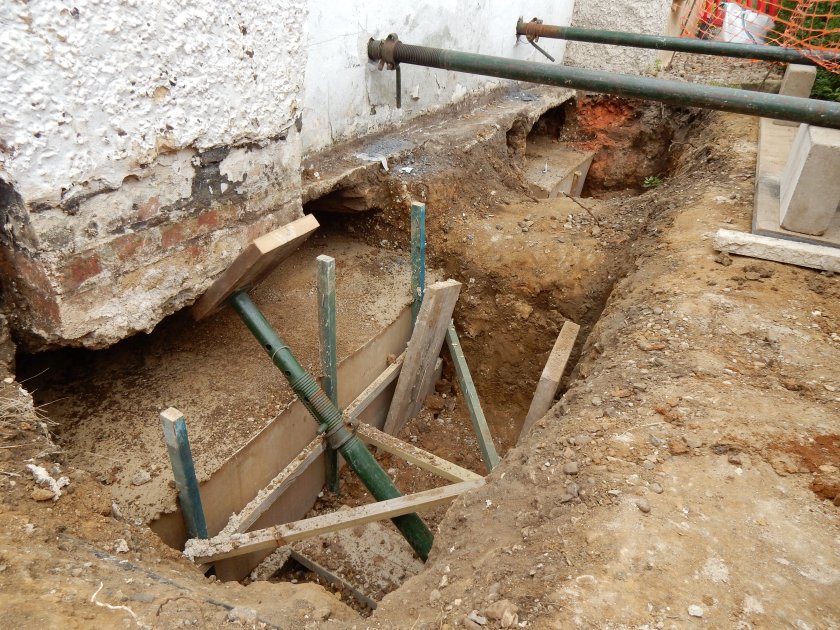
Once the render had set and the wall had been secured work continued breaking up and removing the second concrete slab and finally they reached the earth underneath. As this area had been used as the working smithy for hundreds of years we were hopeful of finding some artefacts. We did find a couple of old, badly rusted tools and some bits of wood but nothing very exciting. Finally they managed to dig down deep enough to prepare the ground for limecrete and lime render as a breathable base for our new floor.
Lowering the floor meant we also quickly lost the stairs to our bedroom and new ensuite. We’ve had to move into the spare room for the duration of the works and back to the bathroom, disappointing having only recently finished and started using our lovely ensuite.

At the same time as digging up the smithy floor the guys also started removing the modern plaster from the internal walls revealing the wattle and daub and more recent renovations underneath in the cottage part of the sitting room. A previous owner had repaired some of the damaged panels with breeze blocks which will have to come out and be replaced with new wattle and daub to make it breathable. More surprising was the lack of any panels filling in the timber frame in the space under the front window. No wonder it’s been an expensive place to keep warm!

In the smithy part of the sitting room the beams turned out to be modern wood painted black and fixed to breeze block walls so they have all come out. The breeze block will be plastered with lime render giving it the same finish as the rest of the sitting room, just without the faux beams.
While digging out the smithy floor the builders also started to remove the cement floor in the cottage part of the sitting room and the modern brick fireplace hopefully to reveal something older. This was soon put on hold to focus on other parts of the project and the original fire place was only revealed a couple of weeks ago with work on the floor ongoing.
One of the challenges during this phase is living and working in the house at the same time as the building work. The sitting room and dining room are completely blocked off as they are a building site and our only access from where we sleep and work in the old house to the new kitchen in the extension is across the garden.
The broadband is also routed through the sitting room to the dining room and protecting that has been a priority. In the end the old telephone wire did snap and I had to organise an emergency call out to repair it so we could maintain our connections with the outside world. Losing that was probably the worst thing that could have happened.
With good progress in the old sitting room our builder moved some of his team to start on the outside of the house. The initial quote was to restore the external wall to the sitting room only but he suggested, and we agreed, that it made sense to tackle the whole of the outside in one go. Suddenly the project and the cost had gone up a few gears along with the disruption. Hopefully it will all be worth it!
 From life at the desk to living the dream
Wow. I am sure it is going to look amazing and restored to its original glory and totally sympathise with the disruption whilst you are living in part of the house. Looking forward to seeing the progress.
LikeLike
It will. It’s just unfortunate that, unlike a TV programme, we can’t fast forward to the end!
LikeLike